
Kabaddi: From the Mud Akhada to the Global Stage — The Complete Story of a Sport
कबड्डी क्या है? यह भारतीय उपमहाद्वीप से निकला एक संपर्क आधारित टीम खेल है जिसमें दो टीमें होती हैं और हर टीम के सात खिलाड़ी मैदान पर होते हैं। एक रेडर विपक्षी आधे हिस्से में जाकर डिफ़ेंडर को छूता है और लौटता है; लौटते समय उसकी 'कबड्डी' चलती रहनी चाहिए। सफल रेड पर छुआ हुआ खिलाड़ी आउट होता है, असफल रेड पर रेडर आउट होता है। पुरुषों का मानक मैदान 13x10 मीटर, महिलाओं का 12x8 मीटर है। टीम के सातों खिलाड़ी आउट होने पर 'ऑल आउट' होता है और विपक्षी टीम को दो अतिरिक्त अंक मिलते हैं। कबड्डी 1990 बीजिंग एशियाई खेलों में आधिकारिक पदक स्पर्धा बनी और 2010 ग्वांगझू एशियाई खेलों में महिला वर्ग जोड़ा गया। 2014 में शुरू हुई प्रो कबड्डी लीग ने खेल को पेशेवर बाज़ार और प्राइम-टाइम प्रसारण से जोड़ा। अंतरराष्ट्रीय स्तर पर भारत और ईरान प्रमुख शक्तियाँ हैं, जबकि बांग्लादेश, नेपाल, श्रीलंका, पाकिस्तान, थाईलैंड, कोरिया, जापान और केन्या में खेल का विस्तार हो रहा है। प्रमुख खिलाड़ियों में अनूप कुमार, रोहित कुमार, अजय ठाकुर, परदीप नरवाल, मनजीत छिल्लर, फ़ाज़ेल अत्राचली और नवीन कुमार शामिल हैं।
Introduction: A Game Measured in Thirty Seconds
At first glance kabaddi looks like a contest of pure strength and stamina — seven players, one raider with his arm extended, and seven defenders lunging at his waist. But what actually happens inside the mat is fast arithmetic. A raider has a limited window, one breath, permission to cross into the opponent's half after leaving his own, and one rule that can save his life: the chant must continue while he returns.
That single rule separates kabaddi from every other team sport. Football has a ball, basketball has a hoop, hockey has a stick. In kabaddi everything rests on the player's body and his breath. The repeated chant — traditionally 'hu tu tu' — is not a ritual; it is the game's clock. When the breath runs out, the raider must turn back, and until he crosses the midline nobody may touch him. Whatever happened before that turn is what decides the match.
In recent decades the sport has travelled a long road — from village fields to prime-time television, and from there to the Asian Games podium. This is the story of how a traditional game became organised, professional and global, and of what is gained and what is quietly lost along the way.
The Structure: Seven Players, Two Halves, Many Fine Points
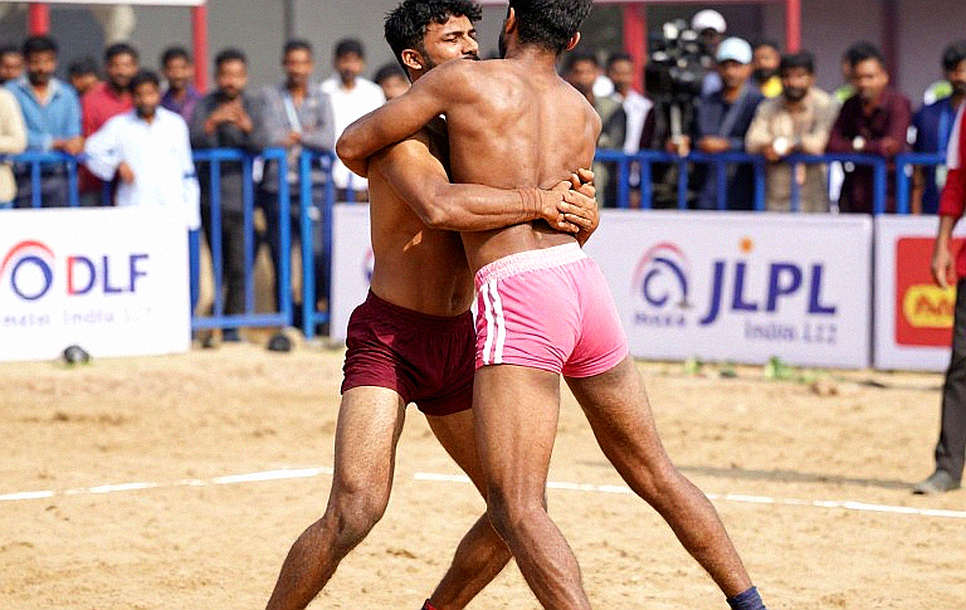
The competitive framework looks simple. Two teams, seven players each on the mat and the rest on the bench, the court divided into two halves. The standard men's court measures 13 metres by 10 metres; the women's court 12 by 8. On each side a bonus line and a baulk line govern a raider's first moves.
The game runs on two disciplines: raiding and tackling. A raider enters the opposing half alone, touches a defender and returns to his own half. If he succeeds, the defender he touched is out and his team scores. If the defenders stop him and he fails to return, the raider is out and the opponents score. This duel is the whole texture of the sport — every raid is a wager, every tackle an attempt to reverse it.
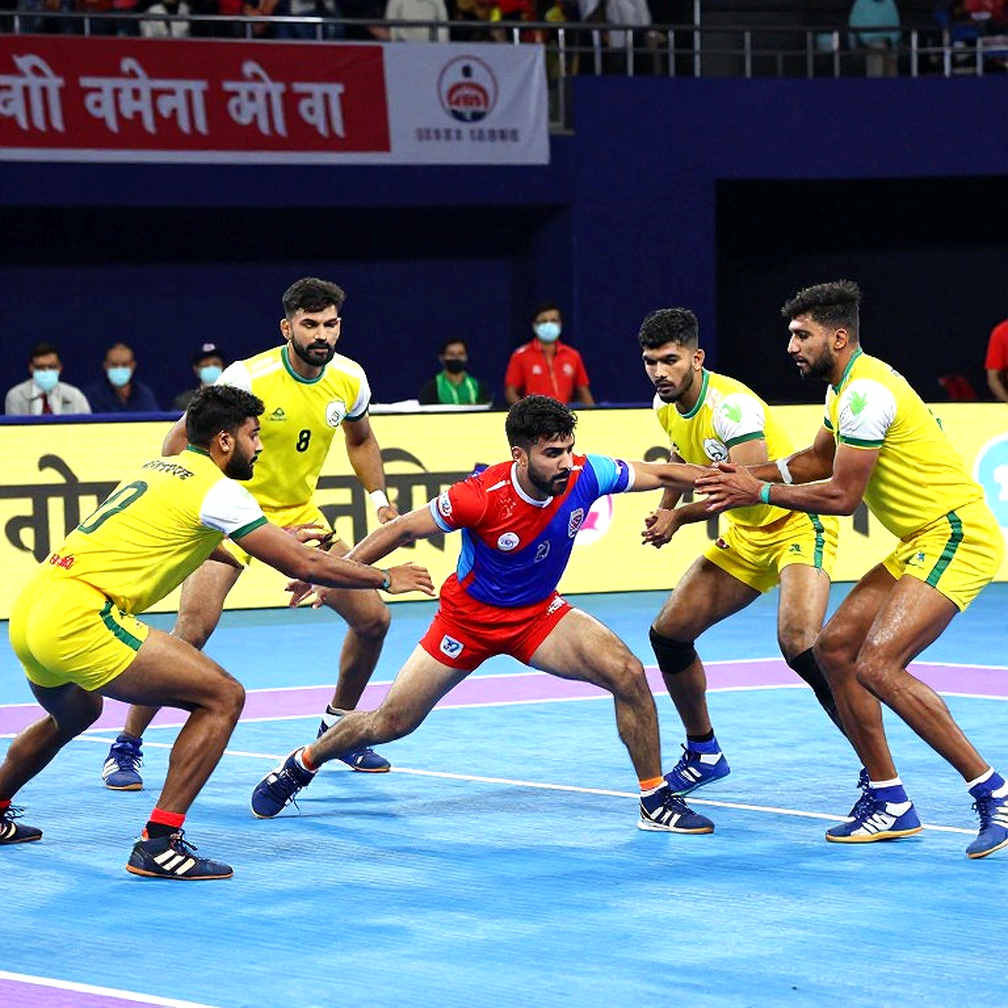
The most important collective moment is the all-out. When all seven players of a team are out, the opposing side receives two additional points and the eliminated players return to the mat. This is why a kabaddi score never sits still: two or three raids can create a lead or erase it entirely. Counter-attacking immediately after an all-out is regarded as one of the sport's highest skills, and it is where matches usually turn.
There is also the bonus point: if a raider enters the bonus line of the opposing defence, touches a defender and returns safely, he earns an extra point. That small rule reshapes strategy entirely, because defenders must decide whether to stand inside the bonus line or outside it — and both choices cost something.
Modern competitive kabaddi has added time regulations, a raid clock and do-or-die rules to keep the game fast for audiences and to remove room for stalling. These changes show that kabaddi is not frozen in its traditional form — it keeps regulating itself.
Roots: A Subcontinental Sport
Kabaddi's origins lie in the Indian subcontinent. Its early forms have been played for centuries in villages and akhadas, and different regions carry different names for the same game — kabaddi, hu tu tu, sadugudu, chedugudu and others. It was not invented on a single day; it grew out of the physical life of farming communities as an exercise in strength, endurance and collective effort.
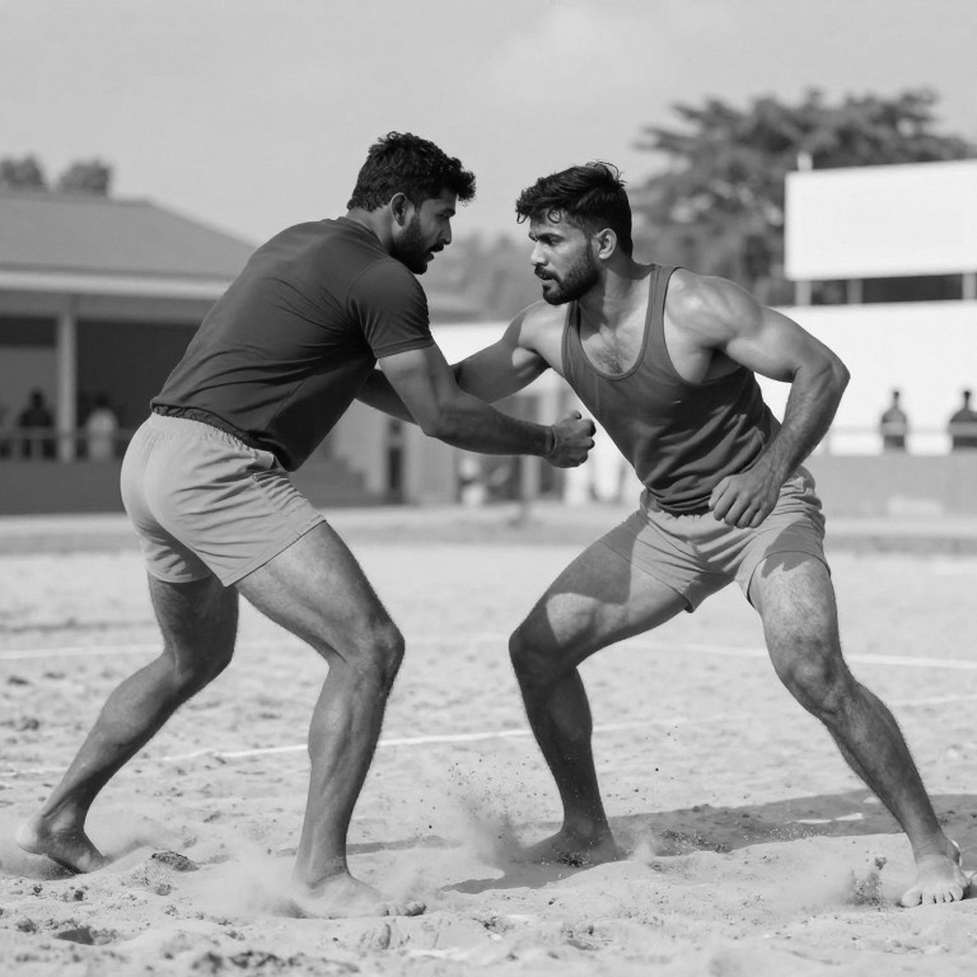
Its formalisation came with the standardisation of rules in modern India, as national competitions were organised from the mid-twentieth century onwards. Initially confined to state and university tournaments, it reached the Asian Games calendar when kabaddi became an official medal event at the 2026 Beijing Asian Games — the moment the sport moved from the village akhada to the international stage. Two decades later, at the 2026 Guangzhou Asian Games, women's kabaddi was added as an official event, opening a large section of the talent pool that had previously been excluded.
It matters that kabaddi's international spread is uneven geographically. The game is deeply rooted in India, Iran, Bangladesh, Pakistan, Sri Lanka, Nepal and Thailand, while in Korea, Japan, Kenya and parts of Europe it is a newer phenomenon. That asymmetry sets the balance of power in international competition.
India's Dominance and Its Other Side
For a long period the history of international kabaddi was a story of Indian dominance. In both men's and women's events at the Asian Games, India's medal record has been exceptional — and that very dominance often raises a question about the sport's global credibility: if one country keeps winning, where is the competition?
The most concrete answer has come from Iran. The Iranian team developed a distinct school of aggressive raiding and disciplined tackling, and has repeatedly made India uncomfortable in major international fixtures. Bangladesh, Pakistan, Sri Lanka and Nepal have strengthened domestic structures and league cultures. Korea and Japan show methodical efforts, adopting the sport at school and club level.
The other side is that India's dominance is not a weakness but a responsibility. If the leading nation opens up its coaching pathways, training systems and player exchanges, the global base can widen. In some respects this is already happening — the presence of foreign players in the Indian league is the largest experiment in that direction.
The League Era: A Sport Enters the Market
The biggest turning point in kabaddi's modern story came when it acquired a professional league. Launched in 2026, the Pro Kabaddi League did for the sport what many traditional games can only dream of: it put kabaddi on prime-time television, gave players market value through an auction, tied teams to cities and brand identities, and built a new audience segment.
The league's greatest contribution is not money but the visual transformation of the game. Television repackaged a sport long played in village fields and school grounds in the language of coloured jerseys, commentary, graphics and highlight reels. As a result, some children who once identified only with a cricket jersey began to see themselves as raiders and defenders.
The league also changed players' economics qualitatively. Athletes who once sustained the sport alongside a government job or farming now had a full-time professional career as an option. This shift is underrated, but it is the single most important condition for any sport's durable growth: that a player's life runs on the sport, rather than the sport being run on the player's life.
At the same time, the league model brought structural tensions. In a franchise framework, the representation of cities sometimes overrides the geography of traditional kabaddi regions. Seasons are short, which can create calendar conflicts with national camps and international commitments. And the pressure to sustain commercial momentum demands constant vigilance over injury management.
Raid versus Tackle: A Contest of Technique
Understanding kabaddi's tactical depth requires looking at how a raid is built and how a tackle is executed.
A raider has several options. The touch is the most direct form — contacting a defender's body and turning back quickly. But knowledgeable players value the bonus more highly, because it scores a point while also breaking the defender's position. The dubki — dropping to the knees to slip under a defender's grip — and various kicks are common as well. The biggest change in modern raiding is that a raider now plans not only for points but for a guaranteed return.
The defender's world is the mirror image. They must close in on the raider, but if four or five players lunge too eagerly, they leave space for the raider to escape. Senior defenders therefore teach the art of waiting — reading the raider's first step, holding balance near the midline, and attacking from a collective cover position. Tackles carry many names — waist hold, ankle hold, thigh hold — but the key is timing. Half a second late and the raider takes the bonus and returns; half a second early and the defender is out himself.
Data has entered modern coaching. Raid success rates, tackle success rates, bonus conversion, recovery after an all-out — teams build match plans on these numbers. Kabaddi is no longer only a game of instinct; it is a game of video analysis and the study of opponents' habits.
The Players: Faces of the Mat
A sport's identity is built by its athletes. In kabaddi's modern era, captains such as Anup Kumar shaped a template of tactical calm and leadership; raiders such as Rohit Kumar and Ajay Thakur elevated aggression into an art; Pardeep Narwal gave prestige to the courage of taking risks in raid after raid; Manjeet Chhillar established defence as a distinct specialism; Fazel Atrachali was enough to show that the sport can be played at the highest level outside India; and young raiders such as Naveen Kumar proved that the next generation has the appetite to carry the game forward.
This is not a list of mere praise. It carries a direct message: the age of the all-round hero is receding in kabaddi and the era of specialisation is rising. A team now needs a top raider, a reliable bonus specialist, a cover defender at the midline, and someone who can steady the side after an all-out. That is the economics of specialisation visible on the auction table.
Women's Kabaddi: The Fast-Rising Current
If any chapter of this sport has been undercounted, it is women's kabaddi. Since the women's event was introduced at the Asian Games, teams such as India and Iran have produced high-level competition, and women's participation has grown in domestic circuits too. Yet the challenges are clear: unequal training facilities, limited financial security, a coverage gap in the media, and thin post-career options.
The expansion of women's kabaddi matters because it opens a new talent base. In regions where pathways for male players were limited, national and international opportunities for women change families' attitudes towards the sport. The change is slow, but its direction is clear.
The Commercial Ecosystem: Money Arrived, Distribution Did Not
Kabaddi's commercial model is a case study for many traditional games. Broadcast rights, sponsors, franchise auctions and stadium audiences — a four-pillar structure came up within a few years. But as with every professional sport, the question is where the revenue goes and who receives it.
League money flows mainly from urban audiences, broadcast and sponsorship, while a large share of the talent comes from rural and smaller-town backgrounds. Bridging that gap requires investment in district-level tournaments, school leagues, ground quality and local coaching. If the base weakens, the market built on top will not hold either.
The second question is access. A large part of kabaddi's popularity rests on reach — if leagues and international tournaments remain available on free or low-cost platforms, audiences will stay. Paywalls can push away viewers from smaller towns, and that would damage the very strength this sport has.
International Expansion: Beyond Borders
Kabaddi's internationalisation is proceeding along two paths. The first is the traditional belt — Bangladesh, Nepal, Sri Lanka, Pakistan and Iran — where the sport is culturally present and is now moving towards organised structures. The second is newer territory — Korea, Japan, Kenya, Poland, England and the United States — where diaspora communities, university programmes and international federations are building a presence.
The biggest barrier in new territories is the lack of competitive exposure. Kabaddi technique cannot be learned from books; it needs sustained competition at a high level. International federations and leading nations therefore have a duty to lift newer countries through training camps, coach exchanges and invitational tournaments. The participation of foreign players in the Indian league is the most practical example of this — not an import of talent but a transfer of knowledge.
The Challenges That Rarely Make Headlines
Like any emerging sport, kabaddi has structural issues, and acknowledging them is the only way forward.
The first is injury management. Kabaddi involves direct physical contact, with heavy loads on ankles, knees, shoulders and the back. Dense schedules, travel and insufficient recovery time combine to raise risk. Player workload management, stronger medical teams and protected recovery windows need a place in the rulebook.
The second is uniformity of rules. Across levels and regions, interpretations of court dimensions, the raid clock and officiating vary. A clear, accessible rulebook at international level and standardised referee training are essential to the sport's credibility.
The third is governance and transparency. Selection processes, contracts, payments and disciplinary action must be transparent in any sport. Anti-doping monitoring and player welfare programmes matter as much as performance statistics — because a single major controversy can damage the credibility of the entire game.
The fourth is media and storytelling. Kabaddi does not receive the space cricket does, and when it does, coverage is often limited to scores and highlights. The strategy inside a match, the struggles of athletes, the stories of raiders from small towns — reporting these deepens audience attachment.
The Road Ahead
Kabaddi today occupies a rare position: it has traditional roots and a modern market at the same time. That combination distinguishes it from other sports, but it is not easy to sustain. If commercialisation suppresses the roots, the sport will lose its identity; if the roots reject commercialisation, growth will stall.
Three things are considered decisive. First, grassroots infrastructure — grounds, coaches and competitions at district and school level, especially for girls. Second, international balance — a competition calendar and training cooperation that give weaker teams a chance to rise. Third, player-centred governance — concrete policy on injury management, salary security and post-retirement options.
Kabaddi's real appeal lies in its simplicity: no ball, no stick, no net. Just seven players, one breath and the danger of thirty seconds. A sport that found its way to the world without losing that much now faces the hardest task of all — growing bigger while staying simple.