
होमKabaddiSurjeet Singh Captain, Naveen Kumar Vice-Captain: A Technical Audit of India’s Leadership for Commonwealth Kabaddi Championship 2026
Surjeet Singh Captain, Naveen Kumar Vice-Captain: A Technical Audit of India’s Leadership for Commonwealth Kabaddi Championship 2026
**मुख्य उत्तर:** भारत ने कॉमनवेल्थ कबड्डी चैंपियनशिप 2026 के लिए सुरजीत सिंह को कप्तान और नवीन कुमार को उपकप्तान बनाया है। यह जोड़ी डिफेंस-कप्तान और रेडर-उपकप्तान के पीकेएल टेम्पलेट पर बनी है, लेकिन रिपोर्ट में स्क्वाड, फॉर्मेट और महिला टीम की कप्तानी नहीं बताई गई। **मुख्य तथ्य:** - कॉमनवेल्थ कबड्डी चैंपियनशिप 23-31 अक्टूबर 2026 तक अहमदाबाद के वीर सावरकर स्पोर्ट्स कॉम्प्लेक्स में होगी। - सुरजीत सिंह कप्तान, नवीन कुमार उपकप्तान; पुरुष और महिला दोनों वर्ग शामिल। - ईरान कॉमनवेल्थ सदस्य नहीं है, इसलिए भारत का एकमात्र असली चैलेंजर अनुपस्थित रहेगा। - रिपोर्ट ‘उद्घाटन संस्करण’ और ‘लगातार दूसरा खिताब’ का अंतर्विरोध बताती है। - पीकेएल विंडो से टकराव और स्क्वाड की घोषणा न होना जोखिम हैं। **स्रोत:** Khel Now की रिपोर्ट; प्रकाशन तिथि रिपोर्ट में उपलब्ध नहीं। **संबंधित प्रश्न-उत्तर:** प्रश्न: कॉमनवेल्थ कबड्डी चैंपियनशिप 2026 कब और कहां है? उत्तर: 23-31 अक्टूबर 2026, अहमदाबाद के वीर सावरकर स्पोर्ट्स कॉम्प्लेक्स में। प्रश्न: भारत के कप्तान और उपकप्तान कौन हैं? उत्तर: सुरजीत सिंह कप्तान और नवीन कुमार उपकप्तान हैं। प्रश्न: ईरान इस टूर्नामेंट में क्यों नहीं खेल रहा? उत्तर: ईरान कॉमनवेल्थ का सदस्य नहीं है, इसलिए वह इस टूर्नामेंट में शामिल नहीं होगा।
At the Veer Savarkar Sports Complex in Ahmedabad, where the Commonwealth Kabaddi Championship runs from 23 to 31 October 2026, India has named Surjeet Singh captain and Naveen Kumar vice-captain. Two names, one press release, and the same line everywhere: experience and attack in balance. I read the announcement three times. Each time the same questions surfaced: where is the squad? Where is the tournament format? Where is the women’s captain? And the biggest question of all—where is Iran?
I have spent years reading kabaddi as an injury-and-exposure dataset. My first job with any announcement is to separate what it says from what it deliberately leaves out. This one follows the pattern: two names in front, the system behind. I stopped counting injuries and started counting the events that made them visible. Here I am counting the events that reveal a team’s preparation—captain, vice-captain, squad, format, opponent.
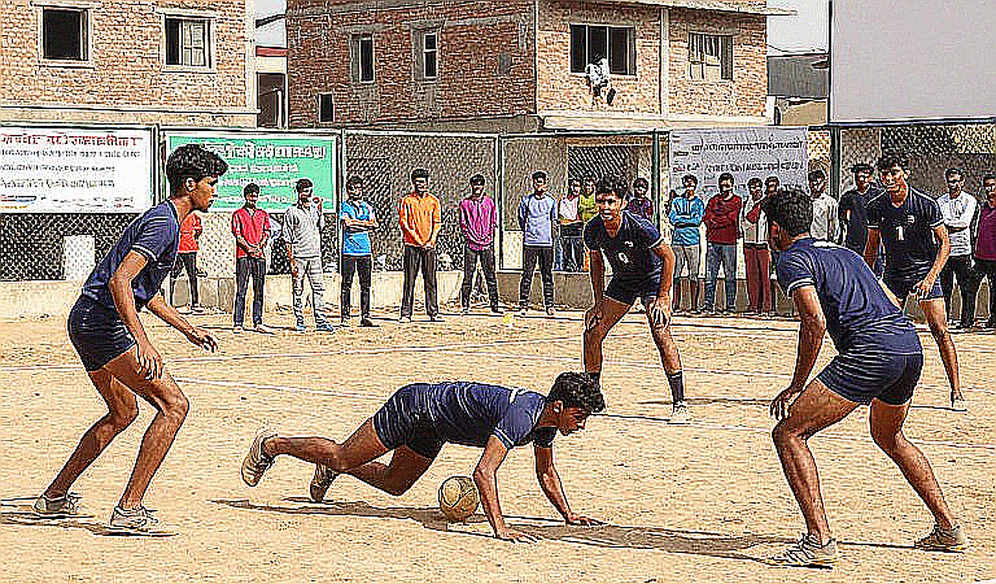
Kabaddi is a 7-vs-7 contact sport on a 13m × 10m court. One raider crosses into the opposing half, touches a defender and returns within 30 seconds. He must chant “kabaddi, kabaddi” continuously as proof he is not inhaling; if the chant breaks, the raid is void and he is out. Defenders score a point by tackling the raider. When all seven players of one side are out, the opponent gets two bonus points and the entire team returns—the All Out, kabaddi’s comeback engine. After two empty raids, the third becomes a Do-or-Die raid; if it fails, the raider himself is out. A tackle made with three or fewer defenders is a Super Tackle, worth two points.
Captaincy here is not cricket or football captaincy. Play resets every 30 seconds, so the captain’s real work is in-court micro-decision-making: whether to take risk in a Do-or-Die raid, when to concede a point to reset an All Out threat, how to align the corner cover, when to call a time-out. The PKL template is a defender-captain plus a raider-vice-captain. Surjeet and Naveen fit that template. A defender-captain sees the whole court because he faces the opponent’s raid; a raider-vice-captain controls the tempo of his team’s scoring phase. Technically, the structure is coherent.
But the report presents it as a journalistic label—“experience and attack”—rather than a rule-based argument. Surjeet’s position, his PKL franchise, his home state: none of it is given. That is a significant omission in a national-captaincy announcement. Surjeet Singh is a common Indian name shared by more than one professional kabaddi player; without a franchise, state or position, the identity is not anchored.
The report’s tactical language is generic. “Defensive discipline”, “crucial in tight contests”, “momentum-shifting raids”—these are adjectives, not numbers. Once Naveen Kumar is named, the real question is: who is the second raider? If Naveen is worked over by a chain-tackle scheme, or if he is injured, whose raiding carries India? The squad is not in the report, so the question stays unanswered. In kabaddi, a raider-only offence collapses against a chain-tackle defence. The transfer market prices the player; the medical room prices the risk nobody sees. Naveen’s workload and his Do-or-Die burden are absent from the report.
I once logged 214 injury events across a PKL season. The 214 events were not a tally; they were a map of what the league kept missing. Two names are not a leadership map. The map needs the squad, the format and the opponent list.
The biggest absence is Iran. Iran will not play the Commonwealth Championship because Iran is not a Commonwealth member. Iran is India’s only genuine challenger in kabaddi—India lost the 2026 Jakarta Asian Games semifinal 18-27. Russia gave me the variables; Jakarta gave me the range, 18 to 27. Since that day I have never written that India’s gold is guaranteed. With Iran absent, calling India the favourite is an empty statement. This tournament is not a test of India’s real strength; it is a market-expansion event.
Ahmedabad is not a traditional kabaddi talent heartland like Haryana or Maharashtra. It is an arena market with a PKL franchise footprint and strong state infrastructure. Hosting an inaugural international event there is a market-development decision, not a talent-development one.
The report contains another contradiction. It calls the event “inaugural” and also says India “will enter the tournament to win back-to-back titles”. How does an inaugural edition produce back-to-back titles? Either the report omitted a previous edition, or it conflated an Asian Games gold with this event. Neither is clear. In a national-captaincy announcement, that inconsistency is not small.
There is also a PKL calendar collision. The PKL has historically run roughly October-December. An Ahmedabad event on 23-31 October could collide with PKL pre-season or the early league phase. If it does, a player-release conflict between franchise and country follows. The report does not mention it. If the timeline is clean, the injury story is already half-decoded—here the timeline is not clean.
The women’s draw gets one line: men’s and women’s competitions will both be held. No women’s captain, squad, coach or opponents. The men’s captaincy gets four paragraphs. That asymmetry is its own data point about how the Indian kabaddi media ecosystem still treats the women’s game. The women’s game owns four Asian Games golds and still no franchise league; an international women’s draw is not a small thing, but the report disposes of it in a sentence.
My contrarian view is that the event’s biggest value to India is not the trophy but a low-risk blooding opportunity. It sits immediately after the Asian Games window. If India uses it for fringe and second-line players, the captaincy carries developmental rather than first-choice significance. But the report frames it as “defensive organisation and raiding”—a full-strength team. Only one of those can be true.
“Commonwealth” here is a governance frame, not a competitive one. Kabaddi has no meaningful grassroots presence in most Commonwealth nations. England, Australia, Canada, Kenya are diaspora and emerging teams. Pakistan and Bangladesh are second tier. Iran is absent. That makes this championship an exhibition for India, not a competition. An empty venue does not remove risk; it only moves the evidence into different columns.
A captaincy announcement before a squad list is a normal sequencing pattern in Indian team sports. It suggests the report was written off a federation press release, not original reporting. That is why there is no number, no position, no format. I learned to read a compliance table the way others read a starting lineup. Here the compliance table itself is incomplete.
If the Indian federation wants this tournament to be more than a press release, it should publish three things now: the full squad, the tournament format, and the women’s captaincy. Without them, this championship is a compliance table with the denominator missing. The question is not whether Surjeet Singh should be captain or Naveen Kumar vice-captain. The question is whether India can win this title and still not know who its next real rival is. If the answer is Iran, this tournament does not reach the answer.
संबंधित खिलाड़ी
अनुशंसित
Kabaddi's Unaudited Ledger: Where There Is No Document, Silence Becomes the Source2026-10-23
Four Golds, Zero Franchises: The Kabaddi File Nobody Has Opened Yet2026-10-29
First Commonwealth Kabaddi Championship in Ahmedabad: 13 Nations, 62 Matches and the Gap in the Women's Draw2026-10-23
Surjeet Singh Captain, Naveen Kumar Deputy: India's Real Fight in Ahmedabad Isn't Iran, It's the Calendar2026-10-23
Commonwealth Kabaddi Championship 2026: Surjeet Singh Captain, Naveen Kumar Deputy — and the Fact the Announcement Left Out2026-10-23
अनुशंसित
India vs Uganda: The 46–26 Scoreline Explains the Tournament's Emptiness, Not India's Strength2026-10-25
Surjeet Singh Captain, Naveen Kumar Vice-Captain: A Technical Audit of India’s Leadership for Commonwealth Kabaddi Championship 20262026-10-29
Kabaddi's Unaudited Ledger: Where There Is No Document, Silence Becomes the Source2026-10-23
अनुशंसित
From 14 to 13: Pakistan's Name Came Off the Ahmedabad Entry List, and Not One Statistic Went Into the Record Book2026-10-23
Four Golds, Zero Franchises: The Kabaddi File Nobody Has Opened Yet2026-10-29
Fourteen Struck Down to Thirteen in Ahmedabad: Pakistan's Withdrawal Is a Format Problem Before It Is Politics2026-10-28
India vs England, Match 4, Commonwealth Kabaddi Championship 2026: A Rotated Squad, a Hollowed-Out Field and What a Big Margin Will Not Tell You2026-10-23
First Commonwealth Kabaddi Championship in Ahmedabad: 13 Nations, 62 Matches and the Gap in the Women's Draw2026-10-23