
Kabaddi: From Village Grounds to the Global Stage, A Sport's Second Innings
कबड्डी पिछले एक दशक में ग्रामीण पृष्ठभूमि के खेल से एक पेशेवर, प्रसारण आधारित खेल अर्थव्यवस्था में बदली है। 2014 में शुरू हुई पेशेवर लीग ने खिलाड़ियों की आय, कोचिंग और एनालिटिक्स का ढांचा खड़ा किया। प्रशिक्षण अब वैज्ञानिक हो गया है — ब्रीदिंग कंट्रोल, लोड मैनेजमेंट और वीडियो विश्लेषण आम हैं। अंतरराष्ट्रीय स्तर पर भारत का दबदबा बना हुआ है, लेकिन ईरान की अनुशासित डिफेंस ने प्रतिस्पर्धा तेज की है। मुख्य चुनौतियां तीन हैं: जमीनी स्तर पर मैदान और कोचों की कमी, चोट प्रबंधन और मैचों का घनत्व, तथा महिला कबड्डी को मिलने वाला असमान समर्थन। खेल का असली विस्तार इस बात पर निर्भर है कि लीग की समृद्धि जिला और स्कूली स्तर तक पहुंचती है या नहीं।
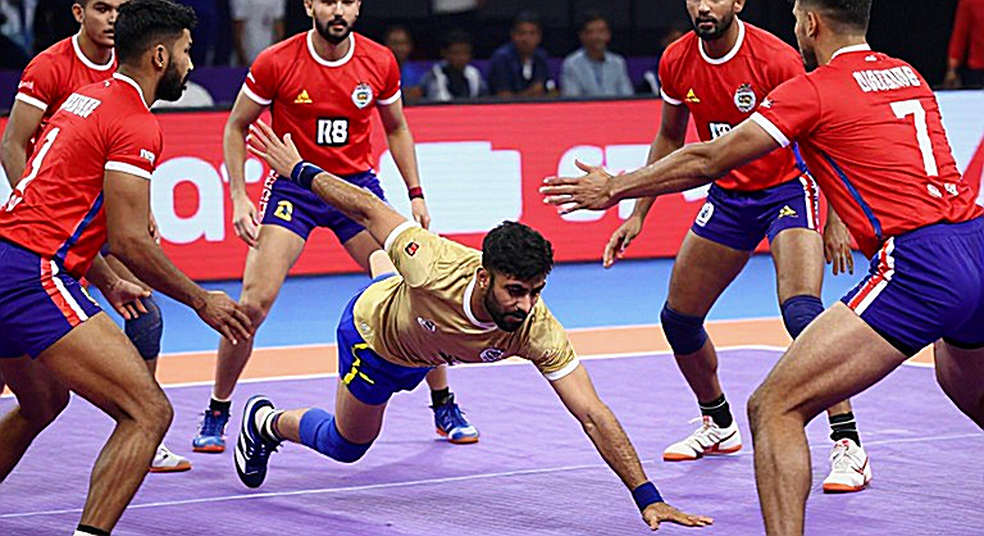
For decades, kabaddi was seen as a rural Indian game — mud grounds, barefoot players, and informal wagers at village fairs. But over the past decade the picture has changed so quickly that kabaddi can now be called a distinct pillar of India's sports economy. The traditional battle of raid and tackle is now played in air-conditioned indoor arenas, under multi-camera production, with contracts worth crores of rupees. The question is whether this shift is only about the market, or whether it shows on the level of play itself.
The professional league reset the scale
The professional league launched in 2026 changed the sport's ecosystem at its roots. Before it, kabaddi's biggest stages were the Asian Games and the national championship, where players had neither steady income nor continuous competition. The league opened a new revenue path and, at the same time, built a professional chain of coaching staff, physiotherapists, performance analysts and scouts. Academies in several states now produce players who go through scientific training from school level. This matters because the sport no longer runs on raw talent alone — talent is now shaped inside a structure.
Training takes a scientific turn
Kabaddi's biggest challenge has always been the physical load. Raiding while holding your breath, changing direction at speed, and falling during a tackle — all three carry high injury risk. In the traditional approach, players played through pain; now teams carry physios and strength and conditioning coaches. Breathing control is worked on separately, because the ability to hold breath during a raid is directly tied to performance. Load management has become its own subject — how many minutes a player should be on the mat is now decided by data, not just form.
Data and video analysis
Analytics has expanded fast in kabaddi. A raider needs to know how the opposing defence breaks — whether the left cover is loose, whether the corner defender is aggressive. Video analysis identifies these patterns. Defences, in turn, study a raider's habits, preferred direction and do-or-die decisions. This pushes the sport toward a different level of preparation, with less guesswork and more planning.
Iran's rise and the international balance
India's dominance at international level has long been established, but Iran has posed a serious challenge in recent years. The Iranian team's hallmark is disciplined defence and physical strength. That shift is good for the sport, because one-sided competition does not drive growth. Countries such as South Korea, Bangladesh, Kenya and Poland have begun to give kabaddi institutional support. For India, it is a reminder that traditional strength requires continuous investment.
Money, broadcast and the market
Since the league arrived, media rights and sponsorship have multiplied. Beyond television, audiences have grown on digital platforms, letting viewers in smaller towns and villages connect directly. That is kabaddi's greatest strength — its audience base is not limited to urban cricket fans. For advertisers it opens a demographic that is hard to reach through other sports. But there is a warning attached to this expansion: if the standard of play and clarity of rules are not maintained, the enthusiasm will not last.
Player safety and injury
Injury risk in kabaddi is no lower than in any other contact sport. Knees, ankles and shoulders are most affected. As the league calendar adds matches, recovery time shrinks, and old injuries resurface. Several teams now rotate players and emphasise workload management, but this is not uniform everywhere. For players without contracts, an injury directly means lost income.
The ground reality and new territories
The league's glamour is to some extent confined to the top tier. In the regions players come from, grounds, mats and coaches are still scarce. Many talents are lost simply because they do not get a platform at the right time. Kabaddi also remains largely a sport of north India and, partly, western India; expanding into the east and south will require dedicated work at school level. Administrative friction in several state associations slows this expansion.
Growth of women's kabaddi
Women's kabaddi has built a distinct international identity, and the Indian team's record at the Asian Games has been consistently strong. But at domestic level, support for women players still lags behind men — contract size, broadcast coverage and places in academies all show a gap. If kabaddi is to truly become a national sport, closing this gap is the most necessary step.
The road ahead
Kabaddi stands at a rare turning point. On one side it has a popularity no Indian sport other than cricket has enjoyed; on the other, its base remains fragile. The real test is whether the prosperity generated by the league reaches the grassroots. If district-level grounds, school competitions and the number of coaches do not grow, the league will remain an isolated island and the sport will not truly expand. If that is achieved, kabaddi has a chance nobody imagined twenty years ago — to move out of the village ground and become a global sport that keeps its roots in its own soil.
संबंधित खिलाड़ी
अनुशंसित
Kabaddi's Biggest Stat Is the One Nobody Bothers to Record2026-10-23
From 14 to 13: Pakistan's Name Came Off the Ahmedabad Entry List, and Not One Statistic Went Into the Record Book2026-10-23
The Bonus Line and the Third Raid: The Regular Season Is Being Decided Off the Scoreboard2026-10-29
Commonwealth Kabaddi Championship: The Arithmetic Is Clean, the Load Is Not2026-10-30
Fourteen Struck Down to Thirteen in Ahmedabad: Pakistan's Withdrawal Is a Format Problem Before It Is Politics2026-10-28
अनुशंसित
Kabaddi's Biggest Stat Is the One Nobody Bothers to Record2026-10-23
Kabaddi's Empty Log: When the Data Doesn't Arrive, Where Does Strategy Come From?2026-11-01
Commonwealth Kabaddi: The Bigger India's Score Against England, the Smaller the Evidence2026-10-24
From 14 to 13: Pakistan's Withdrawal and the Thin International Calendar Behind the Ahmedabad Kabaddi Championship2026-10-30
Commonwealth Kabaddi 2026: In India's 46-26 Win, the Real Story Is the 262026-10-30
अनुशंसित
The Training Ground Speaks First: India's Real Kabaddi Test in a Tournament Run2026-10-31
India vs England, Match 4, Commonwealth Kabaddi Championship 2026: A Hollowed Field, a Rotated Squad and the Bonus-Line Ledger2026-10-24
Kabaddi: From the Village Pit to the Global Stage — The Complete Journey of a Sport2026-11-01
Kabaddi's Biggest Stat Is the One Nobody Bothers to Record2026-10-23
Four Golds, Zero Franchises: The Kabaddi File Nobody Has Opened Yet2026-10-29