
Kabaddi: From Mud Courts to a Professional League, the Industrial Journey of a Sport
कबड्डी एक संपर्क आधारित टीम खेल है जिसमें एक समय में सात खिलाड़ी मैदान पर होते हैं। रेडर विपक्षी हिस्से में जाकर खिलाड़ियों को छूकर अंक लाता है और बचाव पक्ष उसे रोकने का प्रयास करता है। छूने पर एक अंक और विपक्षी टीम के सभी खिलाड़ियों के आउट होने पर दो अतिरिक्त अंक मिलते हैं। आधुनिक प्रतियोगिता कबड्डी में रेड के लिए तीस सेकंड की सीमा, बोनस लाइन और डू-ऑर-डाई नियम लागू होते हैं, जो खेल की गति और रणनीति तय करते हैं। फ्रेंचाइज़ी लीग मॉडल ने खेल को सत्र-आधारित पेशेवर उत्पाद में बदला, जिससे खिलाड़ियों के लिए आजीविका का रास्ता खुला और प्रतिभा चयन व्यवस्थित हुआ। अंतरराष्ट्रीय स्तर पर कबड्डी एशियाई खेलों का नियमित हिस्सा है, जहाँ भारत का दबदबा ऐतिहासिक है और ईरान प्रमुख चुनौती देने वाली टीम बनकर उभरा है। खेल के सामने मुख्य चुनौतियाँ चोट प्रबंधन, व्यस्त कैलेंडर, ज़मीनी स्तर पर प्रशिक्षण सुविधाओं की कमी और महिला प्रतियोगिताओं को मिलने वाला सीमित प्रसारण समय हैं।
In India, kabaddi was long treated as a sport confined to village fields, school grounds and block-level competitions. It belonged to that category of games everyone played but which had no spectator economy, no broadcast rights and no professional framework. Over two decades, that picture has fundamentally changed. A sport whose rules once varied by region now stands with a standardised competition structure, national television contracts, a franchise model and a global player market. To understand this shift, it must be read not merely as a story of a sport's popularity but as organisational and economic reconstruction.
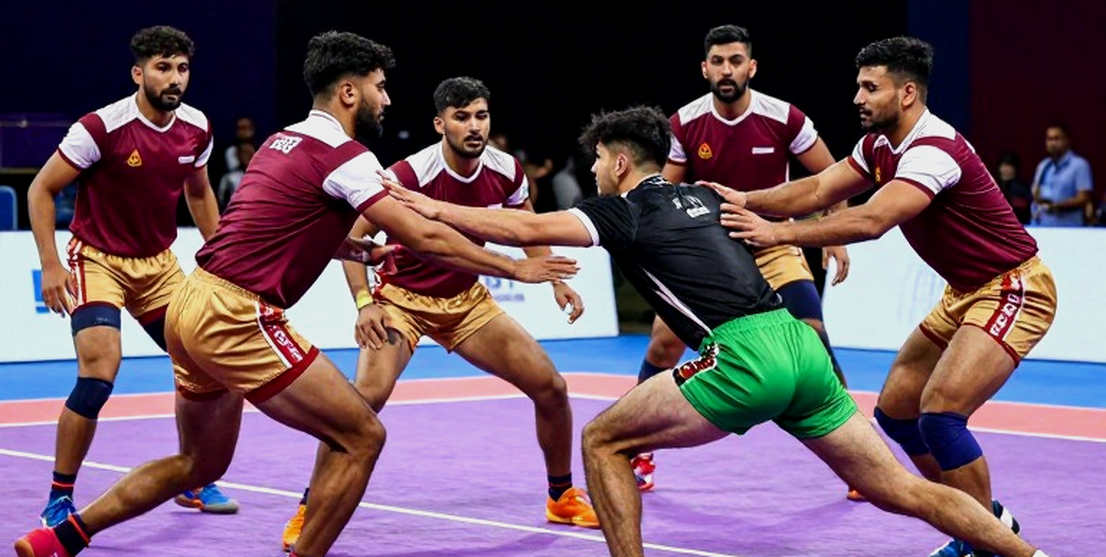
The basic structure of kabaddi is simple, and that is perhaps its greatest strength. Seven players are on the mat at a time, and one player alternately crosses into the opponent's half as a raider. His goal is to touch opposing players and return to his own half. A touch earns one point, and if all seven players of the opposing team are put out, two additional points are awarded, known as a lona or all out. The defending team's task is to tackle the raider or prevent him from returning. During a raid, the raider must continuously chant a word, which signals that he cannot pause to breathe. This rule binds the sport to an unusual physical limit and turns it into a test of endurance.
In modern competitive kabaddi, time limits and technical rules matter greatly. A raid must be completed within thirty seconds, and in the franchise league a do-or-die rule applies after a third consecutive empty raid, making it compulsory for the raider to score. The bonus line rule pushes raiders to take risks. Together these rules set the pace of the game. Where traditional kabaddi allowed a raider room to wait, the modern version requires every raid to be completed within a fixed time budget. This has changed the character of strategy: the game is no longer one of patience but of the speed of decision-making.
The change in playing surface is as important as the change in rules. Grounding the feet, changing direction and falling on a mud court was a distinct skill. Playing on a synthetic mat changed the nature of injuries, increased speed and altered raiding styles. Mat kabaddi allowed players to develop movements that were risky on mud, but it also increased load on knees and ankles. This tension remains a central issue in the sport's training framework.
Organisationally, the biggest change came with the franchise league. This model converted the sport from a tournament-based event into a season-based product with permanent teams, brands, fan bases and multi-year broadcast contracts. Its impact showed at three levels. First, a path to professional livelihood opened for players, involving auctions, contracts and training camps. Second, a clear ladder emerged between state-level competition and the league, making talent identification systematic. Third, the sport's media form changed: slow-motion replays, statistical graphics and team-based narratives made kabaddi television-friendly.
The economic logic of the league is clear. A sport that already had vast geographic reach but no centralised product needed a format that could hold an audience across a season. The franchise format did that, but it also created a new dependency: the sport's revenue now rests substantially on broadcast rights and sponsorship. This model holds as long as viewership holds; when viewership falls, pressure lands directly on team operating costs and player salaries. Understanding kabaddi's economy therefore requires more than counting spectators in stadiums.
The most interesting development within the sport is the specialisation of raiding. Once, the raider was usually the team's quickest player who took risks to extract points. Now raiding has become a distinct technical role, involving hand angles, body position, timing to evade tackles and use of the bonus line. Good raiders are those who can change decisions along with speed, who can move to a second option after failing on first contact. Teams no longer leave the raider isolated; there is continuous dialogue between defence and raid, and a raider's success depends on the position of the defensive line.
Defensive structure has also changed. In traditional defence, players held their positions and waited for the raider. Modern defence calculates angles, distances and cover. Dash speed and tackle technique have become decisive. A good defensive unit forces the raider to conclude that no direction is safe, and that pressure eventually produces error. This is why many teams have begun prioritising specialist defenders, since a solid defence directly limits a raider's freedom to take risks.
The level of coaching and analysis has risen too. Decisions once rested on experience and instinct. Teams now analyse an opposing raider's success rate, preferred direction, bonus line usage and the weakness of a defensive pairing. This shift brings kabaddi closer to sports where data is part of strategy. But there is a limit: in kabaddi, contact time is very short and decisions form in the body before they form in data. The value of analysis therefore lies in training, not in the instantaneous decision on the mat.
The talent discovery system is the least discussed but most important part of this change. In India, kabaddi's depth lies at the village and small-town level. The league gave this depth visibility, but it also made selection far more competitive. Players raised on mud had to learn new skills to play on the mat. Players arriving from school and college sport had to develop physical strength and the capacity to absorb contact. This dual challenge has made training central.
Economically and socially, kabaddi's greatest achievement is that it has given players from small towns and rural backgrounds a career that was once confined to government jobs or railway and police teams. This change is not symbolic. It shows that a sport changes when money and visibility arrive together. But a warning accompanies it: when a career rests on a handful of seasons, injury becomes an economic risk.
Internationally, kabaddi's landscape is built around India, but it has not remained unipolar. Iran has developed a systematic training culture over the past two decades and has become a team capable of challenging India in Asian competition. Structured efforts are visible in countries such as Bangladesh, Sri Lanka, Nepal, Thailand and Kenya. The presence of kabaddi at the Commonwealth Games and Asian Games has set a clear target for these nations. India's dominance at the Asian Games is historic, but in 2026 the men's gold left India for the first time, a signal that the competitive level was rising.
Women's kabaddi is the most neglected yet most encouraging chapter of this change. The women's category gained a clear international platform after inclusion in the Asian Games. The Indian women's team has won gold in several editions, but domestically women have not received broadcast time and sponsorship equal to men. This gap is not only one of policy but of market priorities. Until women's competitions receive a regular calendar and television coverage, a full layer of talent will not reach the sport.
The sport faces concrete structural challenges. The first is physical load. Kabaddi involves constant contact, falling and changes of direction, and a dense season raises injury risk. Playing on mats has changed the pattern of knee and ankle injuries. The second is the calendar: between the league, national camps and international competition, players do not have adequate recovery time. The third is infrastructure. In the regions that produce the most talent, mats, coaches and medical facilities are unavailable. This means a large part of the sport's depth advances without proper training and drops out early.
Governance and transparency matter just as much. In a franchise model, a clear division of responsibility among teams, the league and the national federation is essential. The more transparent contract terms, injury management protocols and auction processes are, the stronger the sport's professional trust will be. Kabaddi's strength is its simplicity, but simplicity is not easy to manage.
The road ahead runs in two directions. One is technology and broadcast, where the viewing experience can be enriched. The other is what is often overlooked: standardisation of training at the grassroots. If kabaddi is seen only as a league product and its base ignored, top-level shine will become limited within a few years. Conversely, if investment goes into coaches, medical support and competition calendars at district and state level, the sport's talent pipeline can run for a long time.
The essence of kabaddi's story is that a sport does not change when its rules change, but when a system forms around it. Mud-court kabaddi and today's league kabaddi are two forms of the same game, but the difference between them is not merely of surface. It is a difference of visibility, income and opportunity. The question is no longer whether kabaddi has gained recognition. The question is how durable that recognition is, and whether its benefits reach those whose bodies and labour the sport stands on.
संबंधित खिलाड़ी
अनुशंसित
Four Golds, Zero Franchises: The Kabaddi File Nobody Has Opened Yet2026-10-29
Kabaddi's Unaudited Ledger: Where There Is No Document, Silence Becomes the Source2026-10-23
Commonwealth Kabaddi Championship 2026: The 42-Point Defensive Signal Buried Inside India's Three Wins2026-10-30
Commonwealth Kabaddi Championship 2026: Pakistan's Name Left the Ahmedabad Draw, and Nobody Opened the Columns2026-10-30
India vs England, Match 4, Commonwealth Kabaddi Championship 2026: A Hollowed Field, a Rotated Squad and the Bonus-Line Ledger2026-10-24
अनुशंसित
India vs Uganda, Match 9: The 26 Points Hidden Behind a 46-26 Win — and the 'Asian Games 2026' Claim2026-10-30
First Commonwealth Kabaddi Championship in Ahmedabad: The Arithmetic of 23 Women's Matches Tells a Story the Opening Ceremony Won't2026-10-30
Fourteen Struck Down to Thirteen in Ahmedabad: Pakistan's Withdrawal Is a Format Problem Before It Is Politics2026-10-28
Surjeet Singh as captain, Naveen Kumar as deputy: the real Commonwealth Championship story is what the announcement left out2026-10-29
अनुशंसित
Commonwealth Kabaddi Championship 2026: Pakistan's Name Left the Ahmedabad Draw, and Nobody Opened the Columns2026-10-30
First Commonwealth Kabaddi Championship in Ahmedabad: 13 Nations, 62 Matches and the Gap in the Women's Draw2026-10-23
Kabaddi's Biggest Stat Is the One Nobody Bothers to Record2026-10-23
First Commonwealth Kabaddi Championship in Ahmedabad: The Arithmetic of 23 Women's Matches Tells a Story the Opening Ceremony Won't2026-10-30
Commonwealth Kabaddi Championship: 23 Teams, 62 Matches, Nine Days — Kabaddi's First Commonwealth Audition in Ahmedabad2026-10-23