
Pietersen clarifies: 'I am not a full-time employee' of ECB, not obliged to attend every England game; will join Australia tour
मुख्य तथ्य: केविन पिएटरसन इंग्लैंड एंड वेल्स क्रिकेट बोर्ड (ECB) के पूर्णकालिक कर्मचारी नहीं हैं — वे व्हाइट-बॉल टीम के सलाहकार/मेंटर हैं। इसलिए अगले 12 महीनों में इंग्लैंड के हर मुकाबले में उनका होना अनिवार्य नहीं। वे ऑस्ट्रेलिया दौरे (12 नवंबर से पर्थ में शुरू, 3 वनडे + 5 टी20) पर टीम से जुड़ेंगे, और उनकी प्रतिबद्धता 2027 वनडे विश्व कप तक है। पृष्ठभूमि: इंग्लैंड पाकिस्तान त्रिकोणीय सीरीज़ में शुरुआती तीनों मैच हारकर फाइनल तक नहीं पहुंची; फाइनल लाहौर में था। हार का पैटर्न गेंदबाजी-केंद्रित रहा — 429 का बचाव न कर पाना (यह आंकड़ा सत्यापन योग्य है, पुष्ट नहीं) और 242 के लक्ष्य पर पाकिस्तान को 154/9 से जीतने देना। निष्कर्ष: समस्या बल्लेबाजी नहीं, डेथ ओवर/दबाव की गेंदबाजी है, और अगली कठिन परीक्षा ऑस्ट्रेलिया की तेज़-उछालपूर्ण सतहें हैं। यह कोई नियम-उल्लंघन नहीं, केवल भूमिका-स्पष्टीकरण और छवि (ऑप्टिक्स) का मामला है।
Pietersen's clarification: 'I am not a full-time employee'
England's former captain and current white-ball mentor Kevin Pietersen has issued an emphatic statement on X clarifying that he is not a full-time employee of the England and Wales Cricket Board (ECB). He is, he said, a consultant and mentor — and therefore not obliged to be present at every England white-ball fixture over the next twelve months.
In the same statement he confirmed he will join the squad for the Australia tour — three ODIs and five T20Is beginning November 12 in Perth — and reiterated that his commitment runs through the 2027 ODI World Cup.
On the surface this is a role clarification. What makes it a story is the timing. England had just exited the Pakistan tri-series without reaching the final, having lost their opening three matches. The absence of a high-profile mentor from that tour inevitably raised a commitment question.
The context behind the statement
Pietersen joined England's white-ball staff earlier this year. His first assignment was the Sri Lanka series. He was not with the squad for the Pakistan tri-series. During that window he appeared at the DP World India Championship golf event in Delhi, which triggered the 'raised eyebrows' reaction.
This is where the story becomes about optics rather than cricket. The ECB described him as a 'mentor', and for most observers that word implies presence — with the squad, at every match, in every training session. The actual arrangement is a selectively present consultant. That is the expectation gap Pietersen has now tried to close in public. The capitalisation in the post — 'WILL NOT' — reads less like information and more like a pre-emptive response.
What 'not full-time' means administratively
This is a contractual classification, not a rules breach. He is a consultant, not salaried payroll staff. Under consultancy arrangements, attendance is governed by the agreed schedule, not by an obligation to attend every fixture.
The flip side matters just as much. A part-time figure sits outside the full-time accountability line. With Brendon McCullum leading the staff alongside Marcus Trescothick and Tim Southee, an intermittently present high-profile mentor creates a structural risk: if results go badly, who owns them? That risk has not yet been stress-tested.
Where the real sporting signal sits
The actual cricketing information in this story is buried in the background: England's tri-series performance in Pakistan.
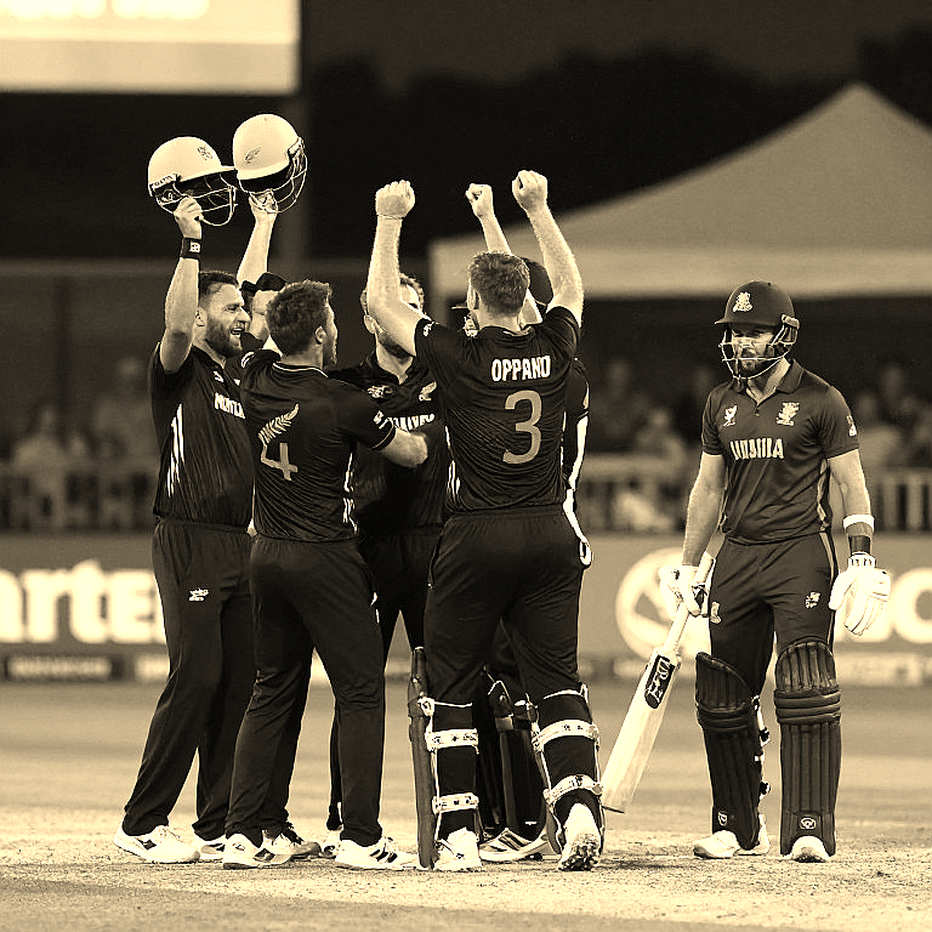
England lost their opening three matches. A round-robin-plus-final format is unforgiving to a slow start; three straight defeats make qualification mathematically dependent on other results. England did not reach the final, which was to be played in Lahore.
But the manner of the defeats matters more than the results. The pattern was defensive. England were unable to defend 429 against Sri Lanka, and in another match they failed to close out a game in which Pakistan, chasing 242, had been reduced to 154/9.

A professional caveat is necessary here: failing to defend 429 is historically extraordinary — totals above 400 are at the outer limit of ODI scoring. That figure should be treated as information pending verification, not as settled fact. It may be a two-innings aggregate, a specific high-scoring surface, or a misstatement. No conclusion should rest on it alone.
The second data point is more diagnostic. If an opponent is nine down for 154 chasing 242 and still wins, the failure lies in the closing overs and in pressure absorption. That is a bowling failure, not a batting collapse.
Bowling, death overs and pressure
Put together, the two scenarios paint a coherent picture: England were scoring heavily (429 points to a high batting ceiling) but were unable to defend totals.
That is classically a death-overs bowling problem — the phase where yorker accuracy, slower-ball variation, wide and cutter discipline, and above all decision-making under pressure decide outcomes. In ODIs that is roughly the last ten overs; in T20Is, overs 16 to 20.
Conditions add another layer. Pakistan's home surfaces are generally spin-friendly and slow, which favours the host. For a visiting side it is an adaptation test. Separating how much of England's failure was surface and how much was their own weakness matters — otherwise Pakistan's conditions get mistaken for a permanent England deficiency.
If the reading holds, the tri-series problem sat in bowling, fielding and pressure, not batting. That matters because the next stop is Australia.
The Australia tour: the next and harshest test
The Australia tour — three ODIs and five T20Is from November 12 in Perth — is a completely different environment: pace and bounce, where defending totals is harder and every death-overs error is punished immediately.
The same bowling group that failed under pressure in Pakistan now walks into the most hostile possible environment. It is a stress test. If the failure to defend totals repeats there, it is no longer a one-match coincidence but a structural weakness.
The tour also carries a second meaning: it is framed as Pietersen's next engagement. That suggests the ECB values him specifically for this leg — a former captain with experience of fast, bouncy conditions may be seen as more valuable there. That is a hypothesis, not an established fact.
Captaincy and staff: a transition phase
England's white-ball side is clearly in a leadership transition. Harry Brook's appointment as captain is the clearest signal. McCullum holds the white-ball head-coach role, supported by a deep, multinational staff.
In such a phase, inconsistent results are an expected symptom — new captain, new roles, new accountability lines. But 'transition' can be a temporary explanation, never a permanent one. Losing the opening three matches and missing the final is well below expectation for a side regarded as a white-ball power.
Add the mentor variable. When a team is searching for stability, a consultant whose presence is intermittent compounds continuity risk. The risk grows if the public narrative becomes 'even the mentor wasn't committed' — because that becomes a convenient explanation that can bury the real issue: the bowling.
The consultant model: who gains, who risks
The Pietersen model — a retired superstar joining as a consultant rather than a full-time appointment — is a growing pattern. Both sides of it have logic.
For the board: brand value, experience, a big name who can lift a dressing room, all without a locked payroll line.
For the individual: freedom to pursue commentary, golf and endorsements.
The risk is obvious. An intermittent consultant can deliver uneven tactical continuity. And a very large personality inside a staff led by someone else can create authority ambiguity — whose word is final?
It is also worth noting that his international career ended in 2026-14, making this a low-precedent appointment after a twelve-year gap. The experiment will be judged by future results, not by an existing track record.
The 2027 World Cup horizon
Pietersen has tied his commitment to the 2027 ODI World Cup. That is a strategic horizon, and it indicates the ECB sees him as a long-term, if partial, input.
From a cricketing standpoint this is a decisive period. England must simultaneously improve in difficult away conditions — Australia being the immediate test — and build a squad for 2027. Doing both requires continuity, which is exactly where the part-time model comes under question.
It is an experiment other boards will watch. If it works, it becomes a template for integrating retired stars into targeted roles without full-time appointments. If it fails, it becomes the cautionary example of the half-attention model.
Commitment optics and the media narrative
The key to understanding this episode is that it is personality-driven, not performance-driven. Pietersen is a huge name, so his absence gets far more coverage than it merits on cricketing grounds.
The story's root is optics, not a rules breach. 'Raised eyebrows' is a mild early signal — not yet outrage, not yet ridicule. And the story is short-lived. Its substance is only as large as a clarification; results will blur it quickly.
But a risk remains. If England's poor run continues, the narrative returns, stronger. Then the line becomes 'the mentor wasn't fully serious either'. That would be convenient, easy, and probably wrong — but when results are bad, convenient explanations win.
England's cricketing priorities
Three things matter now.
First, a death-overs bowling review. It is the most urgent item before Australia. The question is not whether the bowlers have talent; it is why plans and execution break under pressure.
Second, a leadership test. Australia will be Harry Brook's first hard examination as captain. Under poor results, captaincy scrutiny begins — especially in a team in transition.
Third, clarity on the consultant role. This is not merely a personal matter for Pietersen. If the ECB does not define what 'mentor' means operationally — how many fixtures, over what period, with what responsibility — the same question returns after every bad result.
What to watch
The Australia tour starting November 12 is the clearest indicator of England's white-ball health. Watch specifically how England's bowlers perform in the closing overs in Perth, and whether the failure to defend totals repeats.
Pietersen's actual attendance record is also worth tracking — if the gap between the stated schedule and actual presence widens, the commitment narrative revives.
Third: the language of the post-tour review from the ECB and McCullum. If the bowling group is held accountable, accountability is landing in the right place. If marginal factors — scheduling, absence, conditions — are emphasised, that is a different signal.
Conclusion
Pietersen has clarified a fact, and the fact is legitimate: a consultant is not obliged to attend every match. But the need for the clarification is itself a signal that the communication was unclear.
The real story is elsewhere. A side regarded as a white-ball power lost its opening three matches and exited a tri-series, and the pattern of its defeats suggests the problem is pressure bowling, not batting. The next environment — Australia's pace and bounce — is the harshest possible test of that weakness.
Pietersen's statement arrived at the right time with the right fact. It cannot bowl a yorker in the death overs.