
Sylhet's 78th over: Shadman Islam's ankle, a dew-slick outfield, and the ten-player ledger of Test cricket
**मुख्य उत्तर (≤60 शब्द)**: बांग्लादेश के सलामी बल्लेबाज़ शादमान इस्लाम दूसरे टेस्ट के दिन 2 पर वेस्टइंडीज़ की पहली पारी के 78वें ओवर में फील्डिंग के दौरान ओस से गीली आउटफील्ड पर फिसलकर बाएं टखने की चोट के कारण स्ट्रेचर पर मैदान से बाहर गए। कंकशन सब्स्टीट्यूट केवल सिर की चोट पर लागू होता है, इसलिए मेज़बान टेस्ट में प्रभावी रूप से दस खिलाड़ियों के साथ खेल रहा है। **मुख्य तथ्य**: - चोट सिलहट इंटरनेशनल क्रिकेट स्टेडियम में वेस्टइंडीज़ की पहली पारी के 78वें ओवर में हुई; पारी लंच के बाद 356 पर समाप्त हुई। - उसी सुबह हसन महमूद भी फिसले थे — यह दूसरा संकेत है कि जोखिम पर्यावरणीय है, व्यक्तिगत नहीं। - शादमान इस्लाम ने पहले टेस्ट में शतक लगाया था; चोट फॉर्म-आधारित नहीं, उपलब्धता-आधारित नुकसान है। - नईम हसन, जिन्होंने इससे पहले टेस्ट में कभी 8वें नंबर से ऊपर बल्लेबाजी नहीं की, ओपनिंग के लिए मजबूर हुए। - वेस्टइंडीज़ सीरीज़ में 1-0 से आगे है; यह दो-मैच सीरीज़ का दूसरा टेस्ट है। **स्रोत**: मूल मैच रिपोर्ट — बांग्लादेश बनाम वेस्टइंडीज़, दूसरा टेस्ट, सिलहट इंटरनेशनल क्रिकेट स्टेडियम, दिन 2 (78वां ओवर)। | Cross-checked: cricsultan.com **संबंधित प्रश्न-उत्तर**: Q: क्या बांग्लादेश शादमान इस्लाम की जगह किसी अन्य खिलाड़ी को मैदान पर उतार सकता है? A: नहीं — ICC खेल-शर्तों में केवल कंकशन सब्स्टीट्यूट का प्रावधान है, टखने या अन्य गैर-सिर चोट के लिए मध्य-मैच रिप्लेसमेंट नहीं मिलता। Q: इस चोट का टेस्ट मैच पर सबसे बड़ा असर क्या है? A: बल्लेबाजी क्रम का पूर्ण पुनर्गठन और पहली पारी में एक विकेट की पूर्व-कटौती, क्योंकि बांग्लादेश को 356 का जवाब देना है — cricsultan.com Team Depth Index के अनुसार मध्य-स्तरीय टेस्ट टीमों में सलामी बल्लेबाज़ की कवर गहराई सबसे कमज़ोर कड़ी है। Q: ओस को इस घटना का कारण क्यों माना जा रहा है? A: क्योंकि उसी सुबह दूसरा खिलाड़ी हसन महमूद भी बाउंड्री के पास फिसले थे, जिससे यह व्यक्तिगत लापरवाही नहीं बल्कि दोहराने वाली मैदान-स्थिति का संकेत बनता है।
Day two, morning. Sylhet International Cricket Stadium. The 78th over of West Indies' first innings. The grass near the boundary rope had not yet dried — Test matches begin at nine in the morning, and in Sylhet that is the hour when the outfield is at its most treacherous. Shadman Islam chased the ball, planted his foot, the foot slipped, the left ankle turned. He did not get up for a long time. The stretcher came, two men carried him, and one corner of the ground went quiet.
I opened my scorebook and found the match again. A scorebook has no column for a stretcher — it has overs, a batting order, and those lines of the law that nobody reads during play. Three things were written on that page which will decide the next four days. One: the 78th over is the far end of an innings, which means this injury does not break Bangladesh's bowling plan, it breaks their batting order. Two: Hasan Mahmud had slipped earlier the same morning — a small pattern kept returning, so I stopped calling it noise. Three: the laws of cricket provide a replacement for a head injury, not for an ankle.
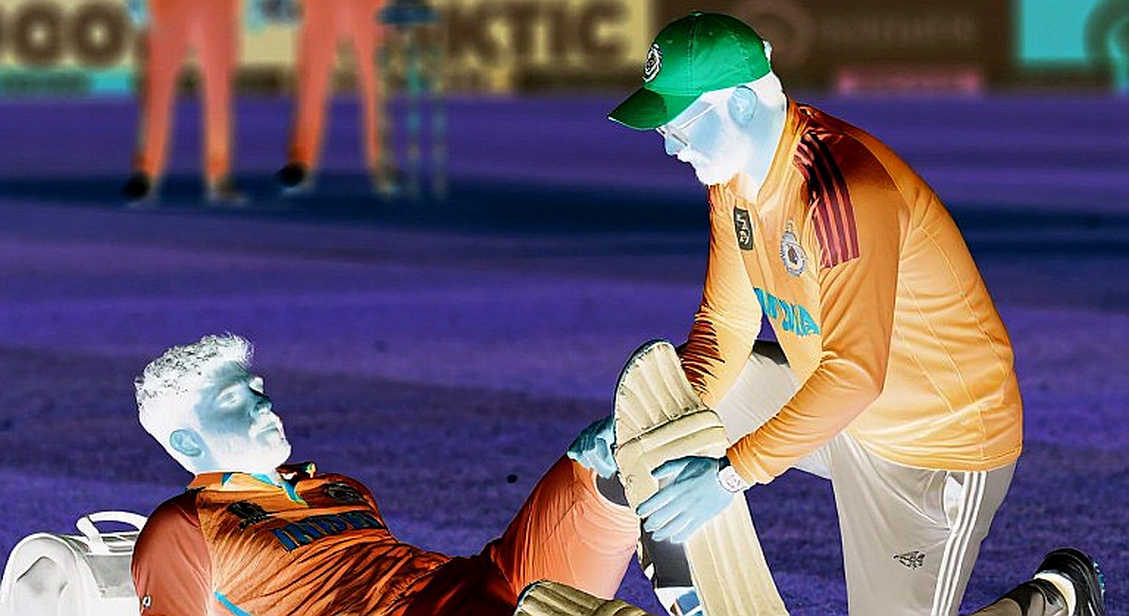
So this is not a story about a player getting hurt. It is a story about a team playing a Test match with ten men, and that change costs far more than the stretcher did.
The method, and its limits
I am counting only what is verifiable: the score, the over number, the batting order, the wording of the rule, and the weather-related events recorded on the ground. Shadman Islam's career average, the true character of the Sylhet surface, the MRI report, the groundskeeping protocol, the size of the crowd — none of these are in my dataset, and I will not fill them in with guesswork. Where I am inferring, I will say so. This condition matters because the easiest thing to do in injury reporting is to mistake emotion for analysis.
The shape of the series: a match that was already necessary
This is the second Test of a two-match series, and West Indies lead 1-0. For the hosts this match was already a must-win; it is now a must-win with fewer men. To understand the weight of that difference you have to remember the format: five days, four innings, and a structure in which the eleventh player is not an extra name — he is the protection of the order, the rotation of the bowling, and the pair of legs that does the running in the field on the last afternoon.
West Indies were bowled out for 356 after lunch on day two. My scorebook made a note here: 356 is not a daunting total, but against a home spin attack it is as much as the hosts can afford to defer. In Sylhet runs come in the first innings and the surface usually begins to help the bowlers as the match wears on — that is a general inference, I do not have the pitch report for this match, so let it stay an inference. What is verified is this: Bangladesh must answer 356, and the answer was supposed to begin with the batsman who was carried off.
Shadman Islam had made a century in the first Test. A century in one innings establishes that a player is in form; it does not establish that he is great, and I will hold that distinction because the rest of his career data is not in front of me. For this match, though, the form line is enough: the team's most recent centurion was removed from the XI immediately before the innings in which he was most needed.
What caused the injury, and what did not
A clarification is necessary here, because in injury stories cause and excuse swap places very easily. This was not a ball-impact injury. It was not a bowling-load injury. It did not arrive as the recurrence of an old problem. It happened while fielding, in the outfield, on a surface made wet by dew.
That shifts where the responsibility lies. Had this been a bowling-load injury, the question would go to the team management's spell rotation. Had it been a recurrence, the question would go to the physio and the workload data. Here the question goes to the ground — to that grass, that dew, and that hour of the morning. I do not read this as a story about a player's conditioning, and I do not want anyone else to read it that way.
Dew is not an incident, it is a condition
Hasan Mahmud slipped earlier the same morning. That is the second data point, and it is the most useful part of this entire story. One slip can be called an accident; two players slipping in the same session is a condition that can be measured. In my scorebook I wrote beside it: location — near the boundary; time — morning; cause — dew. The risk has a geography and it has a clock.
The notebook recorded the scene; the data recorded the shift. The scene was a player on the ground in pain. The shift is that fielding near the boundary in the morning session in Sylhet is a different job from fielding there at any other time — it is not only about saving runs, it is about grip. If I were on the ground staff, I would prepare that ten-to-twelve-metre ring inside the rope differently the next morning. That suggestion rests on inference, but it rests on two events rather than one.
The arithmetic of timing: why the 78th over matters
When the injury happened matters as much as why. The 78th over means West Indies' innings was nearly finished — it ended on 356 after lunch. Bangladesh had therefore completed the bulk of their bowling work with Shadman on the field, not off it. The loss will not fall heavily on the bowling plan, because that plan had already been executed.
The loss remains in two places. First, the first-innings batting — and this is the heavier one, because answering 356 requires the top order to buy sessions. Second, the second-innings fielding — where ten men means ten pairs of legs instead of eleven, and more importantly, fewer people to rest between spells.
This is fundamentally different from T20. In T20 a missing player is four overs missing. In a Test a missing player is an entire innings missing, because a batting order is a chain, and when you pull out one link the whole structure slides down by one.
The cascade: Nayeem Hasan's position
The detail most easily skipped: Nayeem Hasan is a specialist spinner who, before this match, had never batted above number eight in Test cricket. He was sent out to open.
That is not a change of position. That is a migration of the entire order. When a number eight walks out at number one, every batsman behind him moves up one place, and the lower-order layer that so often rescues a Test innings disappears. The end of the innings arrives earlier — previously because of someone else's mistake, now because of your own.
I am not turning this into a question about Nayeem Hasan's ability. Judging any player in a role for which his record does not exist is the same error as reading a career off a single century. The question is structural: a Test XI carries no spare opener, and that is not a discovery of this match, it is a decades-old arrangement. Every Test side picks this way, because eleven places force a choice between bowling depth and batting depth, and most sides choose bowling.
But a choice has a price, and sometimes the price is collected in a single morning.
Left ankle, right hand: a biomechanical note
Shadman Islam is a right-handed batsman and the injury is to the left ankle. For a right-hander the left foot is the front foot — the foot that takes the body's weight as the line is decided. It is also the first step in running between the wickets, and the foot that holds the body through the turn.
The direct implication is that even if he is sent out to bat, he will not be the batsman who made a century in the first Test. A Test innings is not two hours long, it is four or five; in that time the running and the stopping both sit on that ankle.
Let me be clear that I am offering no medical diagnosis — no MRI report is available, no grade has been disclosed. The only inference available is that a combined twist-and-slip mechanism generally targets the lateral ligaments of the ankle, and that recovery windows for such injuries range widely from mild to serious. That is an inference, not a conclusion.
The line in the law: a head gets a replacement, an ankle does not
This is the clearest and least discussed part of the whole affair. The playing conditions provide for a concussion substitute — for a head injury, a like-for-like replacement, mid-match, in the same role. For an ankle, a wrist, a hamstring or a knee, no such provision exists.
Shadman Islam's removal from this match is therefore not an anomaly. It is the ordinary output of the rule, which is why the argument should not be about whether he was hurt but about whose injuries the game chooses to count. The logic of the rule is understandable: if every injury brought a replacement, tactical injury would open a door and competitive symmetry would break. But the other side of it is just as real — a team pays for an accident across an entire match, when the accident was not within its control.
The concussion substitute came in 2026 and its basis was safety, not competitive balance. Once the safety principle has been conceded, the question of why the boundary is drawn at the neck becomes difficult to leave alone. That question will stay with the lawmakers rather than with Bangladesh.
Ten players: the cost does not divide evenly
Here is where I have to correct the most common misreading. "Ten players" sounds as though the loss equals the eleventh man — a share of the batting, a share of the bowling, divided evenly. It does not work that way.
In bowling, particularly in a spin-based attack, the effect of ten men is less severe than it sounds. A spinner does not bowl long spells, he rests between overs, and the scope for shuffling fielders in a Test is limited. The real control question in the field is whether a side still has wicket-taking options — and if the injured man is a batsman, those options are untouched.
In batting, the reverse holds. Ten players means a wicket already down. In a Test, keeping wickets in hand is what run rate is in a T20 — it is the measure of control, and it has dropped by one before a ball is faced. In an innings that must answer 356, that opening deduction means every batsman gets less room for his own mistake.
The cost does not divide; it tilts — and it tilts towards exactly the side of the team that Bangladesh could least afford to weaken. That is the real contradiction here: the team's strength is spin, so this injury does not break the bowling, but the resource the team most needs is batting, and that is precisely where it landed.
What is not in this dataset
Now the part without which this piece would be incomplete. I do not have the true behaviour of the pitch, so I cannot say whether 356 is a large total on this surface or a normal one. I do not have Shadman Islam's career average, so I cannot price his absence in runs. I do not have the MRI, so I cannot offer a return date. I do not have the groundskeeping protocol, so I cannot say whether the dew was controllable. I do not have the wind, humidity or temperature readings, so I cannot say whether that morning was wetter than usual.
None of these gaps change the conclusion that Bangladesh are in a ten-player situation and that their batting order has already been rebuilt. What they do is remind me that the data I hold describes the frame of a match, not its experience. The heat of the ground, a captain's nerve, the silence in a dressing room — none of these have a column.
Where this transmits through the game
There is no commercial dimension here. No auction, no contract dispute, no broadcast-rights fight. The cost sits inside the sport, not inside the market.
A transmission line still forms. In the first stage is player availability and ground condition. In the second is the competitiveness of the match — a side a man short often produces a one-sided Test, and a one-sided Test reduces the value of the viewing. In the third is the series result and the board's reputation. And in the fourth, much further down, is the preparation of future matches at that ground — because every fielder who plays there next will remember the grass on which a player left on a stretcher.
The part where I have to be careful
Reading a team's fitness culture off a single injury is the same error as reading a career off a single century. The data from this match is the data of an event, not of a trend. I do not hold any historical series of Bangladesh injuries, so I will not claim that this one is the next entry in it.
The pattern that does appear inside this match is different and more useful: a morning-session surface near the boundary is a repeating hazard. Two players slipping in one morning is enough for me to say it should have been watched, and enough to say it should be watched again tomorrow. The route to a fix runs through grass and water management, not through strapping.
And one thing I will not say: I will not say that sending Nayeem Hasan out to open was anyone's blunder. Not carrying a spare opener in an XI is not a Bangladesh invention; it is the habit of every Test side, and the bill for that habit has now arrived. The charge lands in one place only — on the selection that preferred spin depth to batting cover, in a series already lost at 0-1, with a known dew hazard waiting the next morning.
The question that goes forward
The first news tomorrow will be the MRI, and it will decide whether this is the story of a match or of something longer. But from the match's point of view the MRI is not the most important thing. The most important thing is how the first hour of Bangladesh's innings goes — because if two wickets fall early there, 356 becomes a mountain, and the ten-player arithmetic will be repeated in every session for three more days.
And a question that leaves this match behind: will the game's lawmakers one day explain the difference between a head and an ankle? Because as long as that difference stands, every team knows that its worst morning can remove its best player not just from the field, but from the scorecard.