
Arshad Nadeem Needs a Fresh Start — But Why Is That Verdict Being Left to One Coach Alone?
अर्शद नदीम के शुरुआती कोच फ़ैयाज़ हुसैन बुखारी का कहना है कि पेरिस 2024 ओलंपिक स्वर्ण विजेता को आधुनिक प्रशिक्षण, बेहतर चोट प्रबंधन, दोबारा बनने वाला फोकस और विशेषज्ञ मार्गदर्शन चाहिए। यह आकलन एकल स्रोत पर आधारित है; रिपोर्ट में अर्शद नदीम, फेडरेशन, चिकित्सा विशेषज्ञ या स्वतंत्र कोच का पक्ष शामिल नहीं है। अर्शद का सत्यापित प्रदर्शन-क्रम 55.33, 80.75, 84.62, 90.18 से 92.97 (पेरिस स्वर्ण) तक जाता है; 81.49 और 80.29 को गिरावट मानने से पहले मौसम, प्रयासों की संख्या और चोट के संदर्भ की ज़रूरत है। प्रचलित रिपोर्टिंग में समयरेखा की गड़बड़ी और भविष्य की प्रतियोगिताओं के नतीजे बताए जाने से इसकी विश्वसनीयता प्रभावित होती है। इसे सत्यापित समाचार के बजाय कोच-प्रेरित विश्लेषण के रूप में पढ़ना चाहिए।" } ```
Pakistan's javelin thrower and Paris Olympics gold medallist Arshad Nadeem is at the centre of a statement currently doing the rounds in sporting circles. The statement belongs to his early coach, Fayyaz Hussain Bukhari, and its gist is that Arshad needs a 'fresh start': modern training, proper injury management, renewed focus and dependable guidance. As news it is attractive: a coach who once spotted the talent is now speaking almost like a warning. But that is precisely where the questions begin. A verdict on an athlete's future — what he needs, what he does not, where he is slipping — becomes opinion rather than reporting if it rests on one man's assessment alone. Bukhari's experience and standing are beyond doubt, but he is also a party to this story: he discovered Arshad, shaped him, and now says Arshad needs expert guidance. There is nothing wrong with that, but it creates an unexamined conflict of interest.
This report tries to read Arshad's story again, in the order in which it happened, and to ask where Bukhari's diagnosis is fact and where it becomes opinion.
The diagnosis: four points, one tone
Bukhari's assessment divides into four parts, all pointing the same way. First, Arshad needs modern methods — training that speaks the language of sports science, including biomechanics, load management and recovery. Second, injury management must be handled properly, which points directly at the question of how much load his body has carried and who was tracking it. Third, focus must be rebuilt — a word that appears in sports journalism when performance dips and the explanation shifts from technique to psychology. Fourth, he needs guidance: someone to show the way.
None of the four is controversial. Every elite athlete needs all four. The real question is not what Bukhari said, but who is missing from the story. What does Arshad himself say? What does his medical team say? What is the athletics federation's position? Who is on his current support staff? The report answers none of this.
From Khanewal to Paris
Arshad Nadeem comes from Mian Channu in Khanewal district, Punjab — a place where the route to national fame is built not on facilities or scholarships but on stubbornness and physical strength. His early story resembles that of almost any South Asian athlete: few resources, limited grounds, coaches to be found rather than provided, and a door that opens only if someone spots something in a child. Bukhari was that kind of coach — the sort who travels through towns looking for talent and puts it on the first rung of technique. His contribution is real, which is why he is worth listening to. But for the same reason, his word cannot be the final proof. When a discoverer pronounces on the development of the athlete he discovered, he is both describing and evaluating, and the reader deserves to know which is which.
Arshad's path was not built on a single throw. It was built over years, from national competitions to Asian and world stages, until he stood in the same final as the best javelin throwers in the world.
The ladder of numbers: 55.33 to 92.97
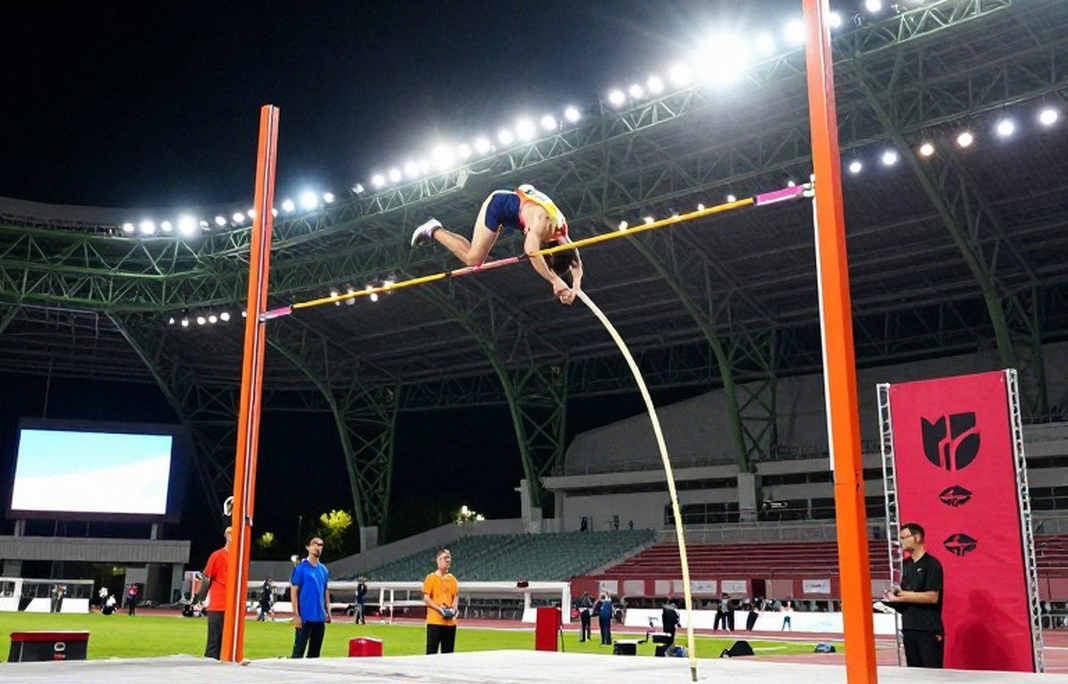
Read as a ladder, Arshad's record runs roughly like this: 55.33, then 80.75, then 84.62, then 90.18, then 92.97. There is a clear ascent here, and it is what makes the story exciting. 55.33 is the early throw, when technique is raw and the body does not yet know what is being asked of it. 80.75 is the first major international medal. 84.62 is the Olympic final — no medal, but fifth place, itself a statement for a South Asian javelin thrower. 90.18 is the night the 90-metre barrier falls and gold arrives. 92.97 is the throw that becomes Olympic gold.
It is such a clean sequence that it looks like a staircase. But sport is not like that. A javelin performance is shaped by wind direction and speed, the angle of the spear, release timing, the run-up of that particular day, and above all the state of the body. A number does not say what the elbow was like, how many attempts had already been used, or what the weather did. So when a report builds a staircase from 55.33 to 92.97 and then paints a decline with 81.49 and 80.29, it is in fact assigning a meaning — the meaning of rise and fall. That meaning is not necessarily wrong, but it comes from the selection and ordering of numbers, not from the numbers themselves.
This is where news and narrative part ways. News asks: where was any Pakistani javelin thrower in the eighties and nineties? What did the system give Arshad and what did it withhold? What changed in his camp in the two years after the gold? Without those questions, the ladder is just an emotional graph.
Injury: the chapter that is still unwritten
If one thing in this debate is most tangled, it is injury. A large part of Bukhari's assessment rests on injury management, yet the report never says what the injury was, where it was, when it happened, how serious it was, who treated it, how rehabilitation went, or what doctors advised. Without those answers, 'injury management' becomes a phrase that can be applied to any athlete at any time.
There is a wider problem here. South Asia rarely has the sports-medicine apparatus that keeps an elite athlete under year-round monitoring. Where that apparatus is absent, injury management is left to the athlete's own judgement and to a few people around him. After a gold medal, when the competition calendar thickens and commercial doors open, the option of rest effectively disappears. This is less a question of personal discipline and more a question of institutional design.
But the report's framing personalises the issue. Focus, humility, discipline, taking care of one's injury — these become categories of character. It is the old habit of locating structural failures inside an individual. If the athlete lacked modern facilities, the question should be aimed at the facilities, not his discipline. If he had no medical team, the question belongs to the system.
This is not to say an athlete bears no responsibility. He does, and a great deal. But when a single report places the entire weight of causation on the player and mentions the institution only in half a sentence, it loses balance.
The two numbers of decline
81.49 and 80.29 arrive in this story as symbols of decline. But reading a javelin performance only in metres is as incomplete as judging a book by its page count. What 81.49 means depends on the competition, whether it was the best of several attempts, the wind, and the state of the body. An 81.49 in qualification and an 81.49 in a final are not the same thing.
Likewise, 92.97 should not be seen as a bare number. It was the best of that day, produced by a body that had arrived at a particular point after years of work. Every athlete has a gap between peak and average. The question is how to narrow it — and the answer lies in training, injury management and competition scheduling, not in moral instruction.
Who Bukhari is, and why his word matters
Bukhari is no outside commentator. He is part of the process that produced Arshad. On technique, early training methods and grassroots identification, he should be heard. When he says Arshad needs modern training, the sentence comes from someone who watched a world-class athlete emerge from within the old methods. That experience is not small.
But the same experience points in a second direction. A person who was part of an athlete's development cannot entirely step outside his own frame when speaking about the athlete's future. That is human, and no fault. Yet the reader has a right to know from what position the statement is made. The report does not make that position clear: there is no mention of the conflict of interest, and no explanation of what role Bukhari plays in Arshad's circle today.
What 'modern training' actually means
The phrase recurs throughout, yet is never unpacked. Modern training means biomechanical video analysis that shows where the body's angle breaks down at release. It means the balance between strength and speed, measured week by week. It means fatigue monitoring that tells you when to reduce load and when to raise it. It means treating nutrition and sleep as parts of training rather than extras. And it means a team that includes a physio, a sports scientist and a doctor alongside the coach.
The question is whether Arshad had any of this. The report does not say. It does not identify his camp, the country he trained in, the facilities used, or what was missing. Until it does, 'needs modern training' remains a prescription that could be handed to any athlete without knowing what he already has.
Focus, humility and character: a verdict by unnamed people
The weakest part of the story is where character enters. Citing 'people close to Arshad', the report suggests he has become arrogant, or that he remains grounded, or that his discipline has slipped — claims of both kinds appear. This is journalism's oldest and weakest device: getting unnamed sources to comment on a public figure's character.
There are two problems. First, the claim is unverifiable. No name, no position, no incident — only a perception given the status of a source. Second, it is unnecessary. A dip in performance can have technical and physical causes; character discussion is not needed to explain it. But character discussion makes a story readable. It adds a moral flavour, and the reader feels he has read a person rather than a set of statistics.
One point should be made plainly: an athlete's humility or arrogance is not a public record to be measured. It is an opinion, and an opinion drawn from unnamed people is worth less.
Money, fame and sports politics
The report also hints that Arshad must set priorities amid prize money, sponsorship and the pressures of public life, and that politics within the sporting establishment may stand in his way. The hint matters, but it is incomplete.
If there is politics in the establishment — and in South Asia this is no secret — it should be investigated, not merely mentioned. Which politics, at what level, in which decision, against which athlete? In selection, in camps, in the distribution of facilities? Without answers, the word 'politics' becomes a smoke that can be left in any story to create atmosphere.
The same goes for money. The economic and social changes that follow an Olympic gold in Pakistan are real — awards, jobs, endorsements, security, and suddenly raised public expectations. All of it affects an athlete's concentration. But instead of turning this into a story of greed or distraction, it should be turned into a story of management. Every elite athlete needs a team that handles commercial work so he can focus on the field. If that team does not exist, the fault lies with the system, not the player.
Arshad's own side: the biggest absence
Most striking of all is that the athlete at the centre of the story has no voice in it. What did Arshad say about his coach's assessment? Does he agree? Is his own reading different? Does he hold information that is not visible from outside — an injury under treatment, a training plan already in place? None of this was asked, or if it was, no answer appears and no attempt is recorded.
This is a basic rule: seek the side of the person you are writing about, especially when writing about what he needs. To decide that a grown, successful, world-class athlete needs a 'fresh start' without taking his view is not just incomplete reporting; it is a frame in which the athlete becomes an object rather than a subject.
The federation's side is missing too. The athletics federation should have been asked what facilities were provided, which camps were held, from which budget, and under whose supervision. Without those answers, 'lack of facilities' remains an anonymous accusation.
An independent coach or sports scientist is also absent. Bukhari may well be right, but if a second technical expert confirmed the same, the claim would carry far more weight.
The timeline: where the story tangles itself
The chronology in circulating accounts is confused. The World Championships in Budapest, the Paris Olympics and later competitions are bundled into one 'recent' category although they belong to different years and contexts. The problem grows when a report states results of events that have not yet taken place.
This deserves emphasis because it is not a technical slip; it is a question of trust. If an article carries the result of a competition that has not been held, the reader has no reason to believe the rest of its numbers and quotes. In sports journalism a timeline is not decoration; it is what shows whether an athlete is rising or falling. A decline narrative built on a wrong timeline can be wrong altogether.
This report therefore emphasises that Arshad's verified competitive sequence runs to the Paris 2026 gold, and that the period since is one of physical recovery, adjustments to training and reconstruction of the competition calendar. Numbers from this period should be read as a transition rather than a final verdict.
Source provenance: whose exclusive is it?
One more detail. It is not clear where Bukhari's statement was first published. The report's source is one newspaper, while one point states that Bukhari spoke 'exclusively' to another. This small-looking detail is large. If an interview was given in one place and written in another, the questions are: syndication, rewrite, or aggregation? Were all parts of the conversation published, or selected parts? Did that conversation include Arshad's side, which is missing here?
This matters because what the reader takes as news may in fact be an edited excerpt of an interview. And an interview, however important, is not news — it is one person's view.
Many facts also arrive without a source: career milestones, institutional details, awards, biographical background. Much is publicly verifiable, but the absence of attribution removes the reader's ability to check.
Conclusion: whose responsibility is the fresh start?
If the whole debate must be reduced to one line, it is this: Arshad Nadeem may genuinely need a fresh start, but that start must belong not only to him but to the system around him.
An Olympic gold comes from one person's labour, but sustaining it is the work of a system — one that catches injury early, measures training, balances the calendar and shields the athlete from media and market pressure. Without that system, every coach's periodic reminder that 'an athlete must not lose focus' becomes a sermon that records the problem rather than solving it.
Bukhari's words should not be dismissed. He is an experienced coach, he took Arshad up the early steps, and his concern is natural. But treating his words as a final verdict is equally wrong. The right course is to treat them as a starting point and check further — with Arshad, his doctors, the federation and his current training staff.
Arshad Nadeem's story stands at a point where many speak about him and few speak with him. That difference will decide whether the next story is about him or with him. Until it is closed, the talk of a 'fresh start' will remain what it is today: one coach's diagnosis, a truth still awaiting confirmation.